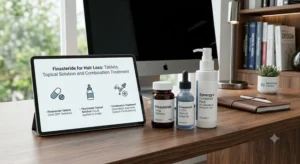
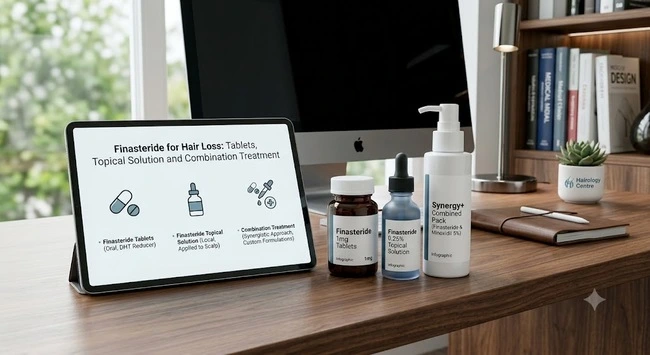
Finasteride is one of the most effective, evidence-based treatments for male pattern baldness (androgenetic alopecia). It works by reducing levels of dihydrotestosterone (DHT), the hormone responsible for the progressive follicle miniaturisation that causes male pattern hair loss.
It is important to understand that finasteride is not a cure for male pattern baldness. Instead, it helps control the underlying process that causes progressive thinning. As long as treatment is continued, many men experience significant stabilisation of their hair loss, and some achieve meaningful regrowth.
How Finasteride Tablets Work
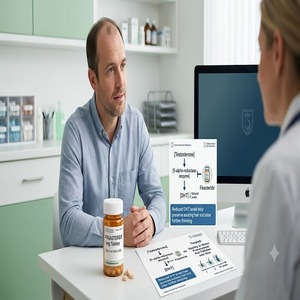 Hair follicles affected by androgenetic alopecia are genetically sensitive to DHT. In susceptible individuals, DHT gradually causes hair follicles to shrink in a process called miniaturisation. Over time:
- Hair becomes finer and shorter
- The growing phase of the hair cycle becomes shorter
- The resting phase becomes longer
- Hair density gradually reduces
- Eventually, some follicles stop producing visible hair
Finasteride tablets work by inhibiting the type II 5-alpha reductase enzyme, reducing scalp and blood DHT levels by approximately 60 to 70%. With less DHT reaching the follicles, miniaturisation slows and many existing follicles are able to produce thicker, healthier hairs.
Finasteride Tablets vs Finasteride Topical Solution: Which Is Better?
Finasteride Tablets
Oral finasteride is the most extensively studied form of treatment and has been used worldwide for many years. Advantages include the strongest long-term clinical evidence, convenient once-daily dosing, effective reduction of scalp DHT, and suitability for most men with androgenetic alopecia.
Topical Finasteride
Topical finasteride is applied directly to areas of thinning hair. The aim is to reduce DHT primarily within the scalp while limiting absorption into the bloodstream. Early clinical studies suggest promising results with lower systemic exposure. It can be combined with topical minoxidil and is convenient for men who prefer not to take tablets. At present, oral finasteride remains the treatment with the strongest clinical evidence.
Finasteride and Minoxidil: Why Combination Therapy Works
 Finasteride and minoxidil work through completely different mechanisms, which is why combining them often produces better results than using either treatment alone.
- Finasteride addresses the underlying cause of male pattern hair loss by reducing DHT.
- Minoxidil works independently by prolonging the hair growth phase, improving follicle activity and increasing the production of thicker hairs.
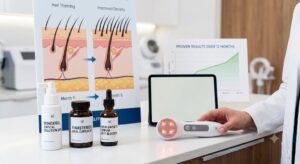
Together, they provide complementary benefits: finasteride helps prevent further follicle miniaturisation, while minoxidil stimulates active hair follicles. For many men with progressive androgenetic alopecia, combination therapy represents the current gold standard of non-surgical hair loss treatment.
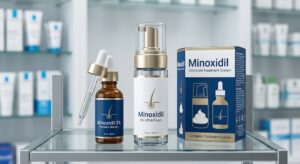
Minoxidil and Finasteride Topical Solution: A Combined Option
Combination topical solutions containing both minoxidil and finasteride have become increasingly popular. A combined topical solution allows patients to apply both medications in a single daily routine, delivering treatment directly to the scalp. This offers a simpler treatment routine, direct application to affected areas, and the convenience of two evidence-based treatments together.
Combined topical solutions are not suitable for everyone. Factors such as scalp sensitivity, the extent of hair loss, lifestyle and previous treatment history are all considered during assessment. For patients requiring stronger DHT suppression, dutasteride may be considered as an alternative or addition to finasteride.
Side Effects: An Honest Clinical View from Mandeep
One of the most common questions I am asked is whether finasteride is safe. Like any medication, finasteride can cause side effects, but it is important to put these into context.
The vast majority of men take finasteride without experiencing significant problems. The most commonly reported side effects include:
- Reduced libido
- Difficulty achieving or maintaining an erection
- Reduced ejaculate volume
- Breast tenderness or enlargement (rare)
- Mood changes, including low mood in a small number of patients
In clinical practice, these side effects occur in a minority of men and are often reversible after stopping the medication. My approach is always to have an open and balanced discussion. Rather than focusing solely on potential benefits or potential risks, I believe patients deserve honest, complete information so they can make an informed decision.
How to Get Finasteride at The Hairology Centre
 Finasteride is a prescription-only medicine and should only be prescribed following an appropriate clinical assessment. At The Hairology Centre, we begin by identifying the underlying cause of your hair loss. You can start with an online assessment at treatments.hairologycentre.com or book a hair loss consultation at hairologycentre.