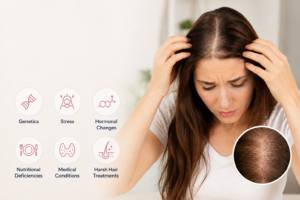
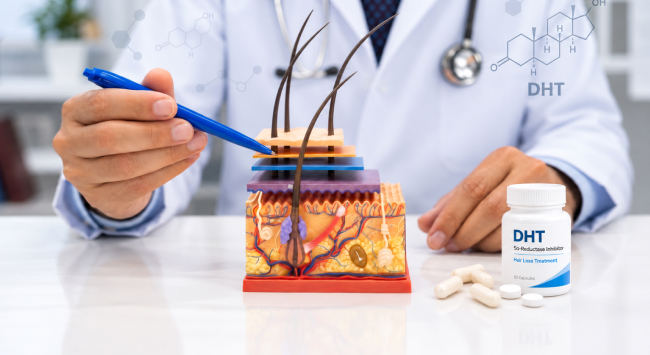
Hair loss is a common concern for men, particularly when it appears as a receding hairline, thinning crown or widening area around the temples. One of the main factors involved in male pattern hair loss, also known as androgenetic alopecia, is a hormone called dihydrotestosterone (DHT).
Understanding the role of DHT can help you explore suitable hair loss treatments and decide when to seek professional advice.
What Is DHT and Why Does It Cause Hair Loss?
 DHT is a hormone produced when testosterone is converted by an enzyme called 5-alpha reductase. In men who are genetically sensitive to DHT, the hormone can attach to receptors in susceptible hair follicles and have a detrimental effect.
Over time, this may cause a process called follicular miniaturisation. The affected follicles gradually produce hairs that are finer, shorter and less pigmented. The growth phase may also become shorter, resulting in visible thinning.
DHT-related hair loss commonly affects the:
- Temples and frontal hairline
- Top of the scalp
- Crown or vertex
- Areas where the hair becomes progressively finer
Not all hair loss is caused by DHT. Sudden shedding, patchy bald areas, scalp inflammation and hair loss following illness may have different causes and require a different assessment.
Why Are Some Men More Affected Than Others?
Genetics plays a major role in male pattern hair loss. Some men inherit hair follicles that are more sensitive to DHT, while others may have less sensitivity.
The amount of DHT in the bloodstream does not always explain the severity of hair loss. Two men can have similar hormone levels but experience very different degrees of thinning because their follicles respond differently.
Age, family history and the timing of treatment can also influence the pattern and progression of hair loss. Some men notice early signs in their twenties, while others develop noticeable thinning later in life.
How Can DHT Be Reduced?
 Finasteride
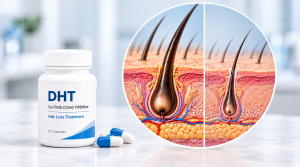
Finasteride is a prescription medicine that inhibits the 5-alpha reductase enzyme, reducing the conversion of testosterone into DHT. It is commonly prescribed for male pattern hair loss and may help slow further thinning while supporting some regrowth.
Possible side effects include sexual difficulties, mood changes and breast tenderness. The MHRA has also issued updated safety warnings concerning psychiatric side effects and sexual dysfunction. A clinician should assess your suitability before treatment.
Dutasteride
Dutasteride inhibits both major types of 5-alpha reductase and can reduce DHT more extensively than finasteride. It is used for hair loss in some countries and may be prescribed off-label for this purpose in the UK.
Its suitability depends on your medical history, treatment goals and the prescriber’s clinical judgement. The evidence and safety profile should be discussed carefully before use.
Minoxidil
Minoxidil does not directly block DHT. Instead, it supports hair growth by increasing cell division, encouraging blood supply to the root of the hair and may help prolong the growth phase of the hair cycle. It is available as a topical treatment and, in selected cases, may be prescribed orally under medical supervision.
Minoxidil is often used alone or alongside a DHT-reducing treatment.
What Should You Expect from DHT-Blocking Treatment?
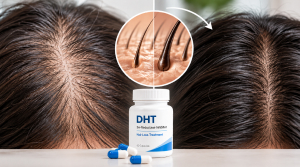 Hair loss treatment requires patience. Some men notice reduced shedding within the first few months, but visible improvement often takes around three to six months, with fuller results assessed at approximately six to twelve months.
Treatment usually needs to be continued to maintain the benefits. If medication is stopped, hair loss may gradually resume.
Results vary according to age, the extent of hair loss, follicle sensitivity, treatment consistency and the underlying diagnosis. Early assessment can help identify the most appropriate options.
Book a Hair Loss Consultation
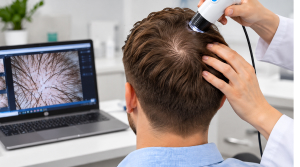 If you are noticing a receding hairline, thinning crown or increased hair shedding, a professional assessment can help establish the cause.
At The Hairology Centre, your consultation may include a detailed medical history, scalp examination and trichoscopic assessment. Your diagnosis and treatment options can then be discussed so you can make an informed decision.
Book your hair loss consultation today and discover which treatment options may be suitable for you.
For more on the causes and types of hair loss, visit our hair loss guide.
Frequently Asked Questions
Does High DHT Always Cause Hair Loss?
No. DHT-related hair loss depends largely on genetic sensitivity within the hair follicles. A man may have normal or high DHT levels without developing significant hair loss, while another man may experience thinning because his follicles are more sensitive.
Can You Block DHT Naturally?
There is limited reliable evidence that diet, supplements or natural products can reduce scalp DHT enough to treat male pattern hair loss. A balanced diet and good general health support hair health, but they should not replace clinically assessed treatment.
How Long Does It Take for DHT Blockers to Work?
Finasteride may require approximately three to six months before early improvement becomes noticeable. Hair density and treatment response are usually assessed over six to twelve months. Individual results vary.
Is DHT Hair Loss Permanent?
DHT-related hair loss can become long-lasting if affected follicles progressively miniaturise. However, treatment may slow progression and support regrowth where follicles remain active. The earlier the condition is assessed, the more options may be available.